Automation has been one of Desma’s core areas for decades. Where do you still see significant potential today?
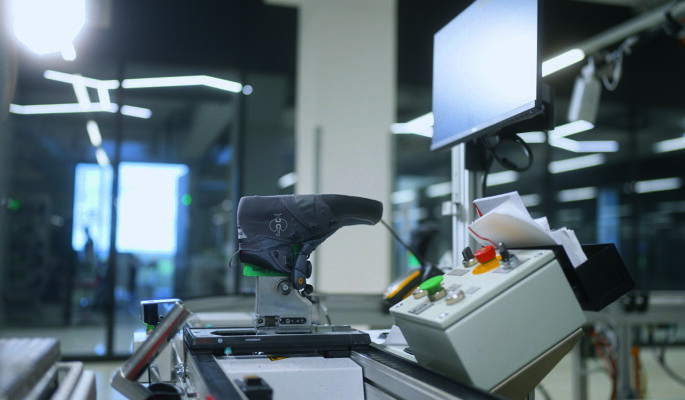
We see considerable potential in processes that are still performed manually today. These include roughing processes, release-agent and spraying processes, handling and adhesive application. In addition, labour shortages are increasing worldwide. In many manufacturing countries, footwear factories are competing with other industries for workers. We therefore need to automate as many physically demanding or repetitive tasks as possible. As we always say: “automate what you hate”. We also see opportunities beyond our traditional core business of direct soling. Around 90 per cent of shoes are still cemented. There is enormous potential for automation solutions in these processes. For example, we are installing a line in South Korea and supplying another large automation line to Turkey. This is an important field for us going forward.
What role does artificial intelligence play in this?
Internally, we already use AI to speed up administrative processes. In automation, however, we are still at an early stage. In future, AI could, for example, help automatically identify different soles, materials and geometries. The ideal scenario would be for completely different soles to travel along a conveyor belt beneath a scanner, with the system itself identifying the material and geometry and then applying the appropriate primer and adhesive. The key is to make these systems as simple and intuitive to operate as possible. At present, changing between models can still involve too much effort. If we can simplify that, automation can take a major step forward.
Could this automation eventually bring more footwear production back to Europe?
No, I do not see that happening. Reshoring and nearshoring have been discussed for years. But the reality is that labour costs are not the only factor. Much of the entire material supply chain and the relevant expertise are located in Asia. A supply chain like that cannot simply be relocated to Europe or the US. Local production can work for selected products and business models, but not for mass production.
Desma generates around 90 per cent of its business internationally. Where are you currently seeing growth?
Interestingly, our strongest growth this year has been in China. That may initially seem surprising because there are now numerous competing machines available there. Some of these systems even look confusingly similar to ours. But when customers compare them directly, they notice differences – in injection technology, automation precision and reliability, for example. That is precisely why we need to play to our strengths consistently: Made in Germany, durability, reliability, service and spare-parts availability. These are the assets that will enable us to remain successful in the future.
Klaus Freese, who has had a major influence on Desma, has stepped down. What do you want to preserve from his approach?
Klaus Freese had a very strong focus on customer orientation and networking. One of the things he always used to say was: “We don’t sell machines; we solve problems in footwear factories.” I agree with that 100 per cent. We need to listen carefully to what our customers need rather than developing things in an engineering office and then trying to push them into the market. I also want to continue the emphasis on partnerships and networking. That was very evident at our in-house exhibition. For the first time, we had 60 co-exhibitors. There will be another in-house exhibition in 2028.
Where do you deliberately want to set different priorities?
Cost awareness, restructuring and reorganisation. These areas received less attention in the past because economic conditions were better and there was less pressure. It also makes a difference whether you are part of a large MDAX-listed group, where you play only a relatively small role on the balance sheet, or whether you are the flagship company of a medium-sized owner.